 US Dollars
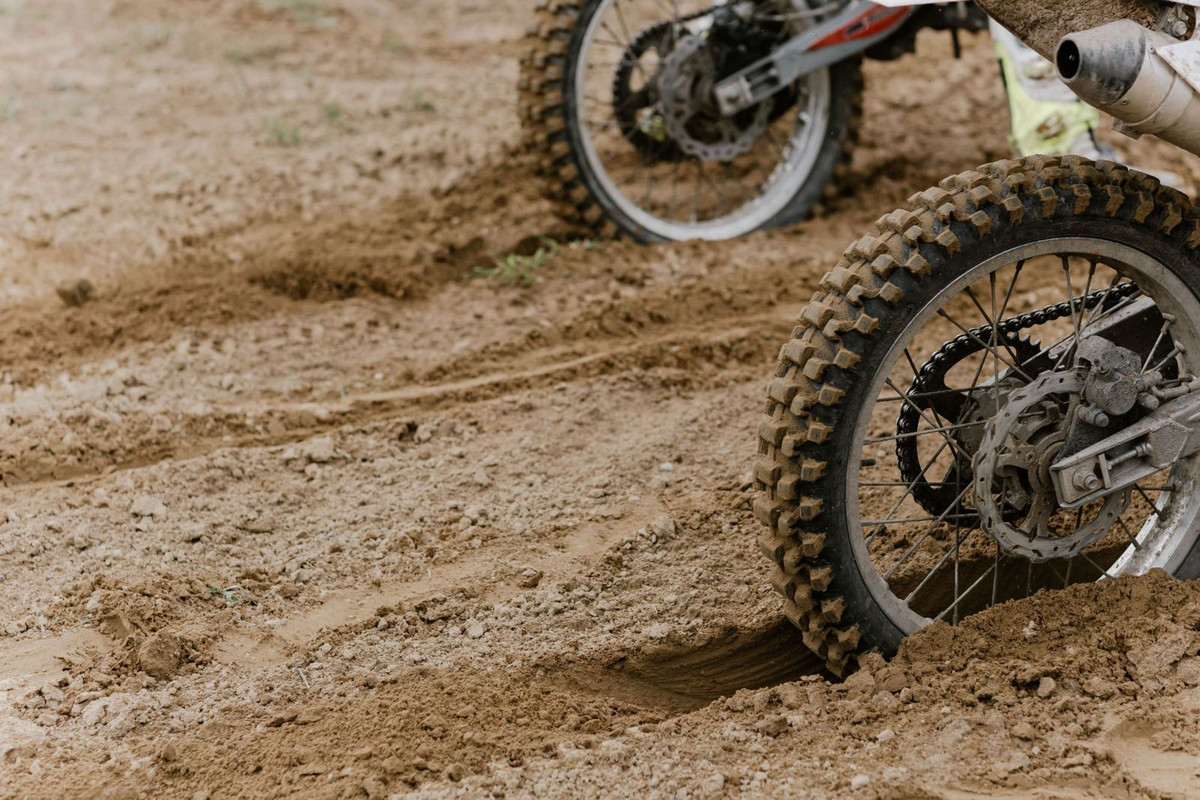
Every spring somebody rolls into the shop with a rear tire that "still has plenty of tread" and a story about how the bike won't hook up anymore. Nine times out of ten the tire is the story. Knobbies don't wear out the way street tires do. The rubber is still there, so it looks fine on the stand, but the part that actually does the work is gone. Here's how I check mine, what the wear patterns mean, and what I'd put on next.

A knobby works with its edges, not its height
On dirt, a tire grips by digging the leading edge of each knob into the ground and pushing against it. A brand-new knob has a sharp, square corner. That corner is what bites under braking, what drives the bike forward out of a rut, and what holds the front end in a flat turn. As the tire wears, that corner rounds off long before the knob gets short. A tire can have 80 percent of its knob height left and ride like a slick, because the edge that does the biting is gone.
So forget tread depth for a minute. Run your thumb across the knobs on the center of the rear tire, front to back. New feels like a stair step. Done feels like a speed bump.
Five ways to tell a dirt bike tire is finished
1. Rounded or chamfered knob edges
The number one sign, and the one most people ignore. Look at the back edge of the center knobs on the rear and the front edge of the knobs on the front. If the corner has turned into a slope, the tire has lost most of its braking and drive bite. It will still roll fine on a fire road. It will not stop the way you expect when you grab a handful of brake into a corner.
2. Chunked or torn knobs
Missing knobs, knobs with a piece torn off the side, or knobs with a crack running across the base. Rocky trails and hardpack with embedded rock do this, and so does an old tire that's gone hard. Once knobs start tearing, the rest follow quickly because each one that goes puts more load on its neighbors. A rear that's chunking is a rear that's about to spit knobs on every jump face.
3. Cupping on the front
Fronts wear unevenly: one side of each knob wears faster than the other, so the tire develops a scalloped feel when you run your hand around it. A cupped front pushes in corners and wanders on braking bumps. If you've started blaming your fork settings for a vague front end, check the tire first. It's cheaper than a revalve.
4. Cracks between the knobs
Fine cracks in the rubber at the base of the knobs or in the carcass between them mean the compound has dried out. Sun, ozone and sitting in a hot trailer all year do this. A cracked tire can look fresh from across the garage and still let go on a slick root because the rubber no longer conforms to anything.
5. Age, no matter how it looks
Soft-terrain compounds are meant to be used up, not stored. A motocross tire that's three or four years old has hardened enough that it behaves like the wrong compound for every condition. The DOT code on the sidewall tells you the week and year it was made (four digits, like 2324 for the 23rd week of 2024). If the tire on the bike you just bought is older than your kid, replace it before you trust it.
The quick test I use
Find a knob on the center of the rear tire and hold a straight edge across its top. Compare it to a knob on the shoulder, which barely wears. If the center knobs are down a third from the shoulder knobs and the edges are rounded, that's a tire I'd race one more time and then retire to practice duty. If they're down half, it's done for anything with corners in it. For trail riding you can go further, but your braking distances grow with every ride and you'll feel it on the first wet day.
Fronts I replace sooner than most people. The front tire is what keeps you off the ground. A rear that's past it costs you drive. A front that's past it costs you a lot more.
Front and rear don't wear the same
Most riders go through two rears for every front, and that's normal. What isn't normal is mixing a fresh rear with a cupped, hard front, which is where a lot of "the bike feels twitchy" complaints come from. The new rear hooks up and drives the bike harder into corners the old front can't hold. If you're replacing a rear and the front is more than a season old, look at it honestly.
Pressure, tubes and why your tire looks worn out early
The fastest way to destroy a good tire is to run it soft without a rim lock, or to run it hard and let the knobs skate instead of bite. For most of us on a full-size bike, 12 to 14 psi is the window: toward 12 for sand and soft loam, toward 14 for rocks and hardpack where you're protecting the rim and tube. Check it cold, before every ride, with a real gauge rather than the one on the gas station hose. Low-pressure gauges are cheap and they're the difference between knowing and guessing.
If you're running tubes, a rim lock keeps the tire from spinning on the rim at low pressure and tearing the valve stem out. If you're tired of pinch flats, a Nitromousse or the Tubliss system lets you run low pressure without carrying a tube at all. We stock all of it in Tubes & Tubeless.
What to run next
Match the tire to the dirt you ride most, not the dirt you wish you rode. These are the ones I actually run here in Colorado.
- Soft to intermediate (loam, sand, tilled tracks): the Dunlop Geomax MX34. Tall, widely spaced knobs that clean out and find bite in anything that moves. This is the default for most Front Range tracks after they've been watered.
- Sand and mud: the Dunlop Geomax MX14. A scoop pattern that paddles through deep stuff. If you ride the dunes or race in the spring slop, this is the rear.
- Intermediate to hard (hardpack, rocky practice tracks): the Dunlop Geomax MX53. Tighter knob spacing and a compound that holds up on hardpack without tearing. Lasts longer than a soft-terrain tire on our dry-season tracks.
- Trail and enduro: the Dunlop Geomax AT81 or EN91. Both are built for rocks and roots with a tougher carcass, and they wear slower than a motocross tire because the compound isn't trying to win a moto.
- Dual sport with real dirt in it: the Dunlop D606, DOT-legal front and rear, and about as aggressive as a street-legal knobby gets.
Sizes for every one of these are in Dirt Bike Tires. Check your sidewall for the size before you order; a 19-inch rear is the common full-size motocross fitment and an 18 is the enduro and trail rear.
Changing it yourself
A tire change is a 20-minute job once you've done a few and a 90-minute fight the first time. Three things make it go: a pair of proper tire levers (not screwdrivers, which cut tubes), a bead holder to keep the first side in the drop center while you work the second, and soapy water or tire lube on the bead. Put a little air in the new tube before you fit it so it doesn't fold, and check that the bead seats evenly all the way round before you hit full pressure. If you'd rather not fight it, most local shops will swap a tire you bring in for a few bucks, and you still save by buying the rubber here.
Everything above goes for ATV and side-by-side tires too, just with lower pressures and a lot more rubber to look at. Those are in Tires & Wheels.
Questions about which tire fits your bike or your dirt? Hit the chat or send us an email. A human answers, and one of us has probably ridden it.